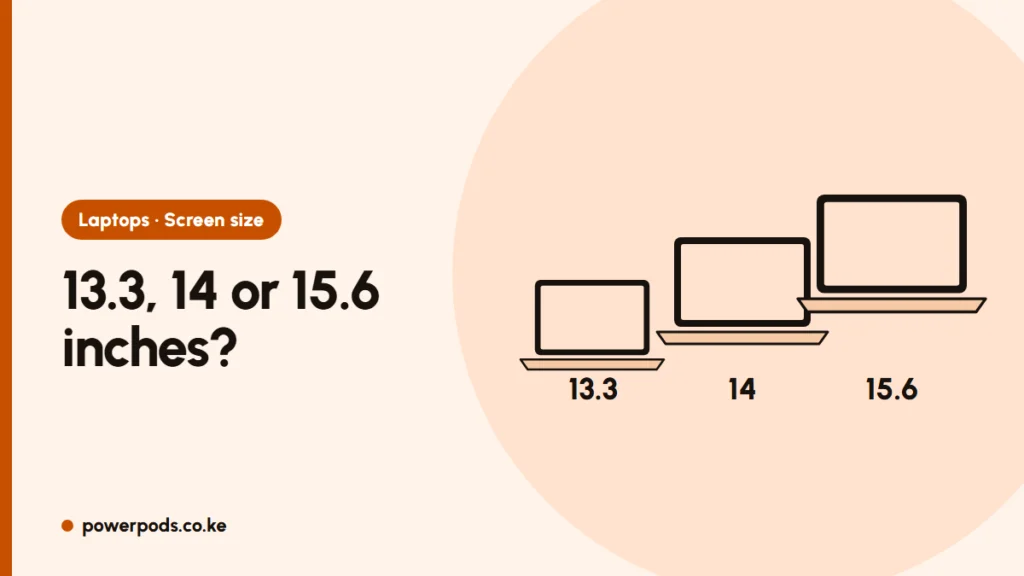
For most people the best laptop screen size is 14 inches: big enough to work on all day, light enough (about 1.4 kg) to carry daily. Choose 13.3 inches if you carry it everywhere, and 15.6 inches if it mostly stays on a desk or you need a number pad.
Sizes compared
| 13.3-inch | 14-inch | 15.6-inch | |
|---|---|---|---|
| Typical business laptop weight | About 1.2–1.35 kg | About 1.3–1.5 kg | About 1.6–1.8 kg |
| Fits a small bag | Yes | Usually | Needs a laptop bag |
| Number pad | No | No | Usually yes |
| Two documents side by side | Tight | Workable | Comfortable |
| Examples | EliteBook 830, Latitude 5330 | EliteBook 840, Latitude 5420 | EliteBook 850, ProBook 450 |
Screen size is measured diagonally. A 14-inch laptop today is often barely bigger than an old 13-inch, thanks to thinner borders.
Who should pick which
- 13.3-inch: students walking between lectures, people on matatus and boda bodas, frequent travellers. Example: Dell Latitude 5330.
- 14-inch: the all-rounder for university, office and home. Example: HP EliteBook 840 G7.
- 15.6-inch: accountants, data entry, people who mostly work at one desk or have weaker eyesight. Example: HP EliteBook 850 G8.
Things that matter as much as size
- Resolution: a Full HD (1920×1080) panel looks sharp on all three sizes. Avoid 1366×768 on 14 or 15.6 inches; text looks grainy.
- Aspect ratio: some newer laptops use taller 16:10 screens, which show more of a page.
- Battery: bigger screens use a little more power, but the battery size and age matter more.
Working at a desk most days? A small laptop plus an external monitor gives you both: see connect two monitors to a laptop. More buying tips in what to look for when buying a laptop.
Quick answers
Usually, yes: it’s lighter and fits bags better, with enough screen for assignments.
Not for typing and browsing. For long spreadsheet work, 14 or 15.6 inches is more comfortable.
Diagonally across the visible screen, corner to corner.