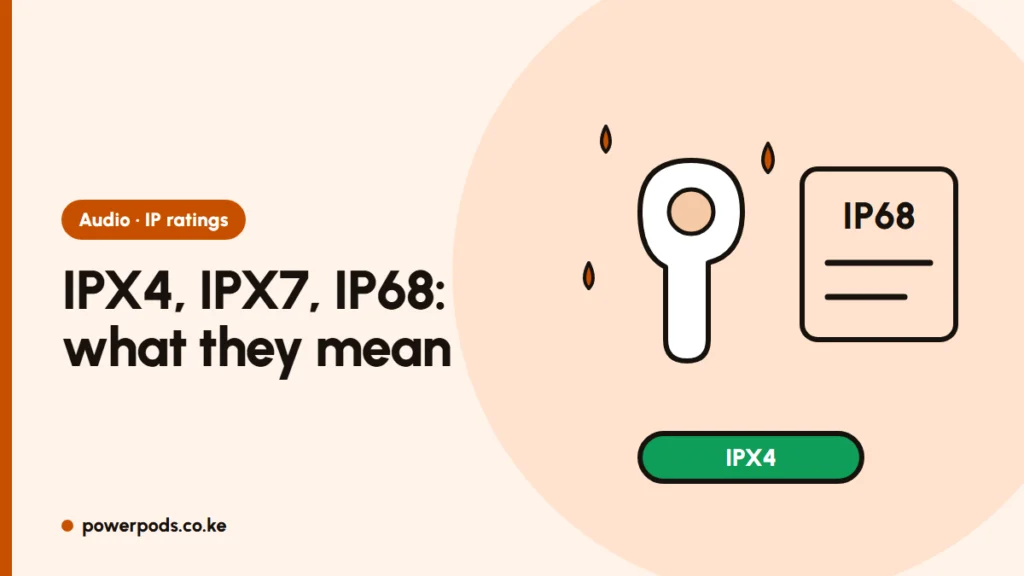
With IP ratings explained in one line: the first digit is protection from dust, the second from water, and an “X” means that part wasn’t tested. So IP68 means dust-tight and safe under water beyond 1 metre, while IPX4 means only splash-proof, fine for sweat and light rain.
How to read an IP code
IP stands for Ingress Protection, from the international standard IEC 60529. The code always has two digits after “IP”:
- First digit, solids and dust (0–6). 5 = dust-protected (some dust can get in, but not enough to cause harm); 6 = dust-tight.
- Second digit, water (0–9). The higher, the more water it survives, up to immersion.
- X = not rated for that part. IPX4 doesn’t mean “no dust protection”, only that the maker didn’t test it.
IPX4 vs IPX5 vs IPX7
These are the ratings you’ll see most on earbuds and speakers:
| Rating | Tested against | Fine for |
|---|---|---|
| IPX4 | Splashing water from any direction | Sweat, gym, light rain |
| IPX5 | Low-pressure water jets | Heavy sweat, rinsing under a tap, a downpour |
| IPX6 | Powerful water jets | Heavy rain, outdoor speakers |
| IPX7 | Dipped up to 1 m for 30 minutes | Dropped in a bucket or sink, quickly pulled out |
| IPX8 | Beyond 1 m; depth and time set by the maker | Brief dunking; check the maker’s exact limit |
IPX4 is water-resistant, not waterproof. It handles a matatu ride home in the long rains, not a swim. Note that IPX7 doesn’t automatically include IPX5; a product that passed both says “IPX5/IPX7”.
IP68: dust and water
IP68 = dust-tight (6) plus immersion beyond 1 metre (8). It’s common on phones and some smartwatches, and useful in Kenya’s dusty dry season and on building sites. The depth and time vary by product (for example “1.5 m for 30 minutes”), so read the spec sheet.
Earbuds with IP54 or IP55 are protected against dust and splashes or jets, which covers most daily use.
What water resistance does not cover
The tests use still, fresh water in a lab. Real life is harsher:
- Swimming: even IPX7 and IPX8 earbuds aren’t designed for swimming. Moving water adds pressure, and Bluetooth barely works under water anyway.
- Sea and pool water: salt and chlorine corrode seals and contacts. Rinse with fresh water if splashed.
- Hot water, steam and soap: showers, saunas and detergents weaken seals.
- The charging case: usually has no rating. Dry earbuds fully before putting them back.
- Age and drops: seals wear out, so an older pair resists less than a new one.
- Warranty: many makers exclude liquid damage, whatever the rating.
Wipe sweat off after the gym and keep the mesh clean; see how to clean earbuds. Choosing a pair? How to choose earbuds covers which rating you need.
Quick answers
Fully dust-tight (6) and protected when submerged beyond 1 metre (8), for a depth and time stated by the maker.
No. IPX4 resists splashes, sweat and light rain, but not submersion.
It’s not recommended. IPX7 is tested for 30 minutes at 1 m in still fresh water; swimming, chlorine and salt water go beyond that.