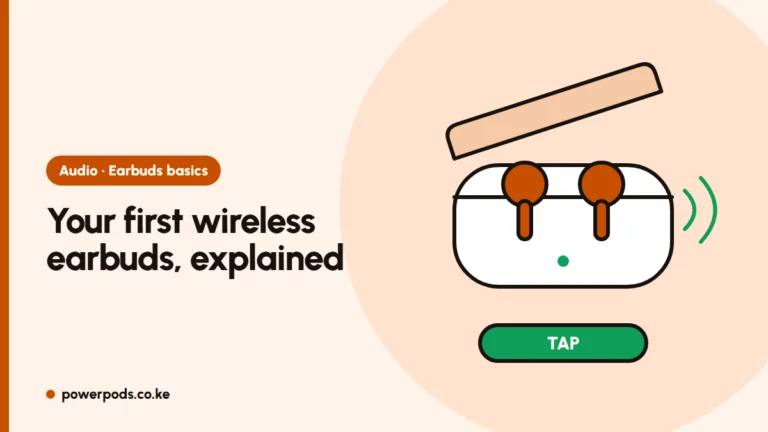
How to choose earbuds: start with fit, then battery, calls and water resistance, and only then compare sound. Earbuds that fall out or hurt after an hour are useless however good they sound.
Updated 29 October 2026.
Fit and comfort first
- Stem style (like a short stick) sits loosely and suits people who dislike the “plugged” feeling.
- In-ear with silicone tips seals better, blocks more noise and gives deeper bass.
- Ear-hook or wing tips stay put for running and gym work.
Most earbuds come with small, medium and large tips. Try every size; the medium tip fitted at the factory is wrong for many people. A good seal makes the bass fuller and noise cancelling work properly.
Battery life and charging
Look at two numbers: hours per charge (the buds) and total hours with the case.
| Use | Look for |
|---|---|
| Commute and calls | 5+ hours per charge, 20+ with case |
| Long days, travel | 7+ hours per charge, 30+ with case |
Claimed figures are measured at moderate volume with ANC off, so expect less. USB-C charging is now standard; avoid odd connectors. Fast charging (10 minutes for an hour of play) helps during KPLC outages.
Calls, ANC and ENC
- ANC (active noise cancelling) reduces noise you hear: matatu engines, office chatter. See what ANC is and how it works.
- ENC (environmental noise cancellation) cleans up your voice on calls, so the other person hears less wind and traffic. It doesn’t block noise for you.
Many cheap earbuds advertise “ENC” prominently. ENC is not ANC. If you want quiet on a noisy commute, look for ANC specifically.
Water resistance
Check the IP rating. IPX4 survives sweat and light rain; IPX5 or higher is better for heavy workouts or getting caught in the long rains. Our guide to IP ratings explains the numbers. No rating listed usually means no protection.
What to expect at each budget (KES)
These are typical, approximate ranges:
| Budget | Realistic expectations |
|---|---|
| Under KES 2,000 | Basic sound, weak mics, short battery, little or no warranty |
| KES 2,000–5,000 | Decent sound, ENC for calls, 5–8 hours, IPX4 common; some have basic ANC |
| KES 5,000–15,000 | Good ANC, app with EQ, better mics, multipoint pairing |
| KES 15,000+ | Flagship sound and ANC, wireless charging, best call quality |
Under KES 5,000 you can get good everyday earbuds; just don’t expect strong noise cancelling.
Spotting fakes and checking warranty
Fake “branded” earbuds are common in markets and on social media. Warning signs:
- Price far below every other seller for a famous brand
- Pop-up name on your phone doesn’t match the brand, or the companion app won’t recognise them
- No serial number, or one that fails the brand’s online check
- Poor printing on the box, missing manuals
Ask what the warranty covers (one bud failing is common) and get it written on the receipt. Once you have them, here’s how to connect earbuds to your phone properly.
Quick answers
Get the fit right first, then check battery life, ANC or ENC depending on your needs, an IP rating and a written warranty.
Comfortable fit, 5+ hours per charge, USB-C, an IP rating, Bluetooth 5.0 or newer, and real ANC if you want quiet.
Decent sound, ENC for clearer calls, IPX4 and 5–8 hours of battery; strong noise cancelling is rare at this price.