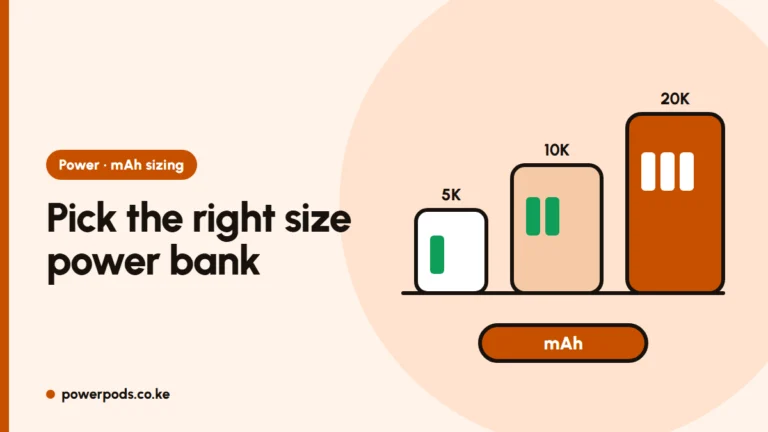
To choose a power bank, match three things to your devices: real capacity, output (watts) and ports. Then check it’s a genuine, marked product, because fake-capacity power banks are common and cheap ones can overheat.
Capacity: real vs claimed
Capacity is printed in mAh (see what mAh means). Two things to know:
- You never get the full number. Some energy is lost converting the battery’s voltage to USB, so expect noticeably less, often around two-thirds of the label, in actual charging.
- Fake capacity is common. A “30,000 mAh” bank that’s light and pocket-sized is usually lying. Real high-capacity banks are heavy.
Rough guide: 10,000 mAh suits a day out with one phone; 20,000 mAh covers a couple of days of KPLC outages or travel; bigger banks are for laptops or several devices.
Output and fast charging (PD, QC)
Output decides how fast it charges.
- USB Power Delivery (PD) over USB-C is the standard for iPhones, most new Android phones, tablets and laptops.
- Quick Charge (QC) is common on Android phones.
- Look for the watts on the label: a phone wants about 18–20 W or more for fast charging.
Your phone, cable and power bank must all support the same standard to charge fast. More in fast charging explained.
Ports and cables
- At least one USB-C port that works both ways (charges the bank and your phone).
- Two outputs if you charge a phone and earbuds together.
- Use a good cable. A thin, cheap cable can cap the speed and get hot.
- A display showing the exact percentage is handy during long outages.
Safety marks and fake signs
A failing lithium battery can swell, overheat or catch fire, so this matters most.
Good signs – Brand name, model, capacity, input/output ratings and watt-hours (Wh) printed clearly. – Safety marks such as CE, plus a KEBS sticker on imported goods. KEBS lets you check a mark’s permit number by SMS to 20023. – A receipt and warranty from a seller who’ll still be there next month.
Warning signs – Huge mAh for a tiny price, or for its weight. – Rattling, spelling mistakes, no Wh rating. – Swelling, heat while idle or a burning smell: stop using it and dispose of it safely, not in household rubbish.
Flying? Airlines generally allow power banks only in hand luggage, and up to 100 Wh without approval. Check your airline’s rules.
For laptops
- Check your laptop’s charger wattage (often 45–65 W or more) and pick a USB-C PD bank that matches it.
- Your laptop must charge over USB-C; older barrel-plug laptops need a special bank or a power station.
- Bigger capacity helps, but keep it within the airline limit if you travel.
Quick answers
Check real capacity, PD/QC output in watts, a USB-C port, clear ratings and safety marks. Avoid huge capacities at tiny prices.
Pick one with USB-C Power Delivery of about 20 W and a capacity of 10,000 mAh or more, and use a good certified cable.
Match your laptop charger’s wattage with a USB-C PD bank, and make sure the laptop charges over USB-C.