Fast charging explained in one line: the phone and charger agree to push more power (watts) than a basic 5-watt charger, usually by raising the voltage, so the battery fills much faster in the first half. For full speed, the phone, charger and cable must all support the same standard.
How fast charging works
Power is volts × amps = watts. An old USB charger gives 5V at 1A, so 5W. A fast charger can give 9V at 2A (18W), 9V at 3A (27W) or more.
When you plug in, phone and charger “talk” through the cable and settle on the highest level both support. If they share no standard, they fall back to slow 5V charging, which is why a “fast” charger can still be slow.
It’s quickest up to about 50–80%, then slows to protect the battery.
USB-PD, PPS and Quick Charge
- USB Power Delivery (USB-PD): the universal USB-C standard. iPhones, Google Pixels, most Android phones, tablets and many laptops use it. Standard PD goes up to 100W; newer chargers and cables rated for it reach 240W for big laptops.
- PPS (Programmable Power Supply): part of newer USB-PD. Instead of fixed steps like 9V, the charger fine-tunes voltage in tiny steps as the battery fills. Less wasted heat, steadier speed. Samsung’s 25W and 45W Super Fast Charging needs a charger that lists PPS; a plain PD charger charges those phones more slowly.
- Qualcomm Quick Charge (QC): common on older Android phones and many power banks. Newer versions (QC 4+ and later) work with USB-PD chargers too.
What to look for on the charger: “USB-C PD” for iPhone and most phones, plus “PPS” for Samsung. The wattage printed on the label should match or exceed what your phone supports.
Brand systems
- Oppo, OnePlus, Realme: SuperVOOC / SUPERVOOC (high current at low voltage).
- Xiaomi, Redmi: HyperCharge.
- Samsung: Super Fast Charging (PPS-based, so it works with good third-party PPS chargers).
Proprietary systems only reach full speed with the brand’s own charger and often its cable. With other chargers, these phones usually fall back to standard USB-PD, which is still reasonably quick.
Trickle charging
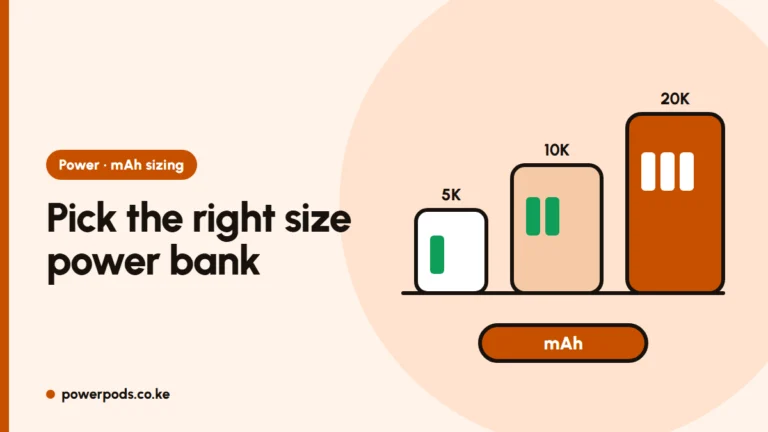
Trickle charging is the opposite: a very small, steady current. On Anker power banks, trickle-charging mode is for low-power devices like earbuds and smartwatches, which can otherwise trick a power bank into switching off. On many models you activate it by pressing the power button twice (or holding it for about 2 seconds) until the light turns green; check your model’s manual. Battery capacity basics are in what mAh means.
Is fast charging bad for the battery?
Not in normal use. Phones slow down when hot or nearly full, and batteries wear mainly from heat and age.
- Don’t charge under a pillow or on a hot car dashboard.
- Use features like Optimised Charging for overnight charging.
- Avoid cheap no-name chargers that claim high wattage. They often lack proper protection circuits, and voltage swings during KPLC outages can stress poor-quality units. A surge-protected extension helps.
Spotting a fake? See how to tell an original Apple charger, and for daily habits, our phone battery charging tips.
Quick answers
Charging at more power than the old 5W standard, usually 18W or more, once phone and charger agree on a shared standard.
A part of USB Power Delivery that adjusts voltage in small steps while charging. It runs cooler, and Samsung’s Super Fast Charging needs it.
Yes, with a genuine or good-quality charger. The phone controls the speed and slows down when it gets hot or nears full.