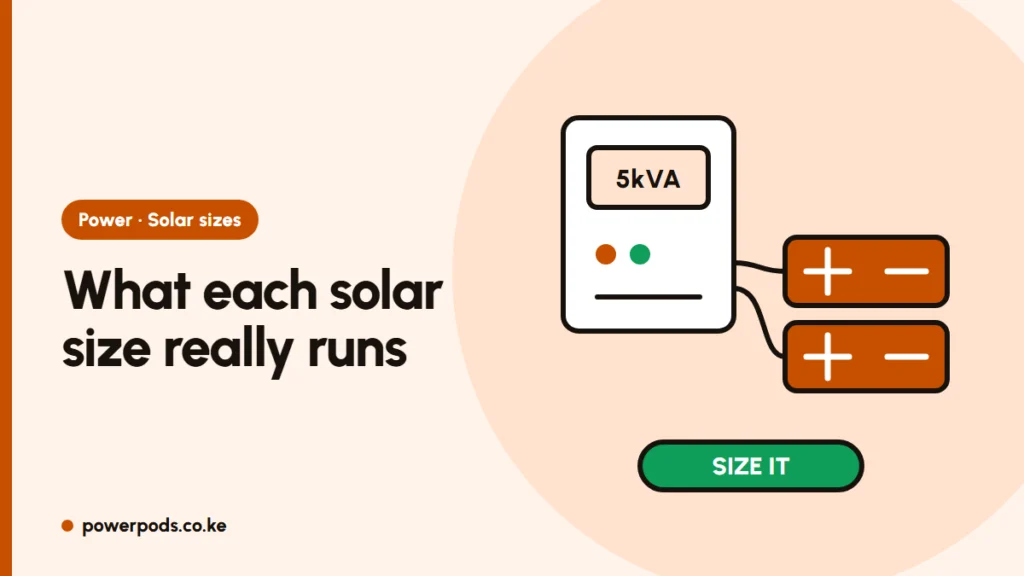
Solar system sizes are named after the inverter: a 1kW system runs lights, TV and Wi-Fi, a 3kW system adds a fridge, and a 5kVA system can run most of a house except heavy heaters. The size you need depends on what runs at the same time, and the battery bank, not the panels, is usually the biggest part of the price.
Updated 30 October 2026.
kW vs kVA
- kW is real power your appliances use.
- kVA is the inverter’s total rating. Real output depends on the power factor, so a 5kVA inverter typically delivers about 4–5 kW, depending on the model. Check the “rated output power” in watts on the spec sheet.
Two other numbers matter just as much: panel watts (how much energy you collect; see what different panel sizes power) and battery kWh (how long you run at night or during a KPLC outage).
1kW: lights, TV and Wi-Fi
Enough for LED lights, a TV, decoder, router, laptops and phone charging. The classic outage backup, often a 1kVA inverter with one or two batteries.
- Typical installed price: roughly KES 70,000 to 150,000, depending on battery type and panel count.
3kW: adding a fridge
Adds a fridge, brief microwave use and a washing machine on a sunny day. Fridges and pumps draw a surge when they start, so leave headroom in the inverter rating.
- Typical installed price: roughly KES 200,000 to 400,000.
5kVA: most of the house
Runs a full family home in the day: fridge, freezer, TVs, computers, washing machine, iron and a water pump (not all at full power at once). Electric showers, cookers and instant water heaters are usually still left on KPLC or replaced with gas or solar water heating.
- Typical price with lithium batteries and installation: roughly KES 300,000 to 700,000.
- A 5kVA hybrid inverter on its own is a fraction of that; most of the rest is batteries and panels.
Bigger 10kW or 10kVA systems suit large homes, businesses and farms.
Batteries: the biggest cost
| Lead-acid (gel/AGM) | Lithium (LiFePO4) | |
|---|---|---|
| Usable capacity | about half | about 80–90% |
| Typical life | a few years | often 10 years or more |
| Upfront price | lower | higher |
| Maintenance | more | very little |
Lithium costs more upfront but usually works out cheaper over its life. A 5kWh lithium battery alone typically costs well over KES 100,000.
Cost drivers: battery kWh, inverter brand (hybrid inverters with a built-in MPPT controller cost more; see PWM vs MPPT), panel count (see solar panel prices per watt), roof work and wiring.
Selling power to KPLC
Kenya has net-metering rules that let approved home systems feed surplus power to the grid for credit. You must apply to Kenya Power and get the right meter first, and exports are credited on terms set by the regulator, so check current rates with KPLC before counting on savings.
Quick answers
Most of a house: fridge, freezer, TVs, computers, a washing machine, iron and a pump, as long as you don’t run them all at full power together. Heavy heaters and electric showers are usually excluded.
Roughly KES 70,000–150,000 for a 1kW backup, KES 200,000–400,000 for 3kW and KES 300,000–700,000 for a 5kVA lithium system installed. Get site-surveyed quotes.
Add up the watts of everything you’ll run at the same time, add the start-up surge of fridges or pumps, then pick an inverter about 25% above that.