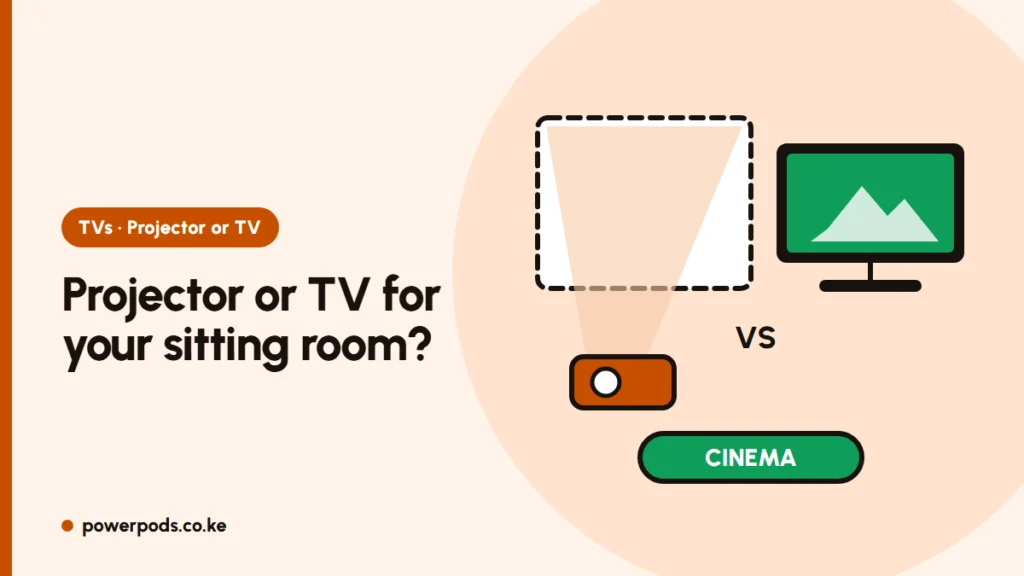
Projector vs TV comes down to light: a TV is better for everyday watching in a bright sitting room, while a projector wins on screen size per shilling for movie and football nights in a room you can darken. Most Kenyan homes that want both end up with a TV for daily use and a projector for big occasions.
Updated 30 October 2026.
Picture quality and daylight
A TV makes its own light, so it stays bright and punchy with the curtains open. A projector bounces light off a wall or screen, and daylight washes it out.
- For a room with some light, look for roughly 2,500 to 3,000 ANSI lumens; a dark room needs far less.
- Be wary of cheap projectors claiming “18,000 lumens” or “4K”. Those are marketing numbers; many mini projectors have a low native resolution and only accept a 1080p signal. Check native resolution and ANSI lumens on the spec sheet.
Size per shilling
| Option | Typical KES | What you get |
|---|---|---|
| Pocket mini projector | about 10,000 to 15,000 | Big but dim and soft; dark room only |
| Entry projector | 15,000 to 35,000 | Big picture, needs a dark room |
| Full HD home projector | 35,000 to 80,000 | Sharp big picture, copes with some light |
| 4K or laser projector | 80,000 to 300,000+ | Cinema-style picture |
| 55″ 4K smart TV | about 37,000 to 75,000 | 55″ picture, bright in daylight |
| 65″ 4K smart TV | about 80,000 to 90,000+ | 65″ picture, bright in daylight |
Budget extra for a proper screen and speakers; built-in projector speakers are small. Check seating distance with the TV viewing distance chart.
Eye comfort
Projector makers say reflected light is easier on the eyes than a TV, but there’s little independent research comparing the two. What clearly matters for both: sit at a sensible distance, avoid a screen much brighter than the room, and take breaks.
Running costs: lamps, power and noise
- Light source life: lamp projectors last roughly 3,000 to 6,000 hours and dim before they fail, so budget for a new lamp. LED and laser models are rated 20,000 hours or more.
- Noise: projectors have cooling fans you can hear in quiet scenes. TVs are silent.
- Dust: Kenyan dust clogs projector filters and lenses; clean them regularly.
- KPLC outages: both stop. A lamp projector cut off mid-film skips its fan cool-down, which can stress the lamp, so don’t switch it straight back on; let it cool first. A small UPS avoids the problem.
- Free-to-air: most projectors have no TV tuner, so you’ll need a decoder plugged in by HDMI. See free-to-air decoders.
Who should pick which
Pick a TV if: you watch daily, in daylight, with news, kids’ shows and free-to-air on all day.
Pick a projector if: you can darken the room, have a big blank wall, and mostly watch films, football and gaming at night, or you want a screen you can move to the compound or a church hall.
Still deciding on a TV? Start with how to choose a TV.
Quick answers
Not for daily viewing in a bright room. A projector is better value for a very large picture in a dark room.
There’s no strong evidence either way. Distance, room lighting and breaks matter more than the device.
Yes, if you can control light and add a decoder for free-to-air and decent speakers. Many homes find a TV more practical for everyday use.