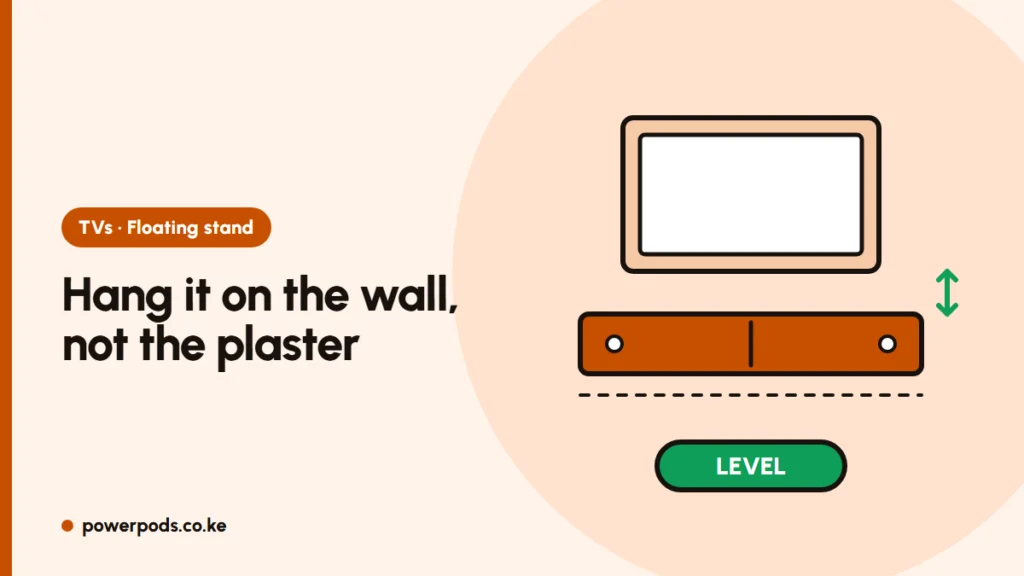
To install a floating TV stand, fix its bracket or rail to solid wall with masonry anchors (or to the frame behind a gypsum wall), level it, then hang the unit on it. It works like a strong shelf: all the weight hangs on the fixings, so the wall type and the screws matter more than the unit itself.
How floating stands are held up
A floating stand, often made to measure by a local carpenter, hangs on one of these:
- A metal rail or wooden cleat screwed to the wall, which the unit hooks onto.
- Steel L-brackets hidden underneath.
- Screws straight through the back panel into the wall (simple, but needs a strong back panel).
Most floating units carry the decoder, router, soundbar and console, not the TV, which should be on its own wall mount. A unit meant to hold a TV needs much stronger fixings and the maker’s weight rating.
Choosing height relative to the TV
Set the TV height first: the centre of the screen at roughly seated eye level, about 100–110 cm from the floor (see TV mount height). Then place the unit below it:
- Gap between TV and unit: about 10–30 cm, so the soundbar doesn’t block the screen.
- Unit bottom off the floor: commonly 20–30 cm, which leaves room to mop underneath.
Fixings by wall type
| Wall | Fixing |
|---|---|
| Stone or concrete | Hammer-drill with a masonry bit; heavy-duty wall plugs or concrete anchors |
| Hollow block | Anchors made for hollow walls or blocks (check the packet’s rating) |
| Gypsum / drywall partition | Screw into the metal or timber studs, or have plywood backing fitted behind the board; hollow-wall toggles only for light loads |
Never rely on plain plastic plugs in gypsum board. The board crumbles under a loaded shelf. Check the anchor’s rated load and allow a generous safety margin, because people lean on units and pull drawers.
Step-by-step install
- Empty and weigh what will go on the unit (decoder, soundbar, console, books).
- Check for cables and pipes behind the wall, especially below sockets and switches.
- Mark the height with a pencil and spirit level, using the TV as your guide.
- Drill and plug at the bracket or rail holes. Use at least as many fixings as the maker supplies, spread across the full width.
- Fix the rail or brackets, check they’re level, then hang or screw on the unit.
- Load test gently with your hands before putting electronics on it.
- Route the cables through the back or a trunking channel: see how to hide TV wires.
For the TV itself, follow how to mount a TV on the wall. Renting and can’t drill? See how to mount a TV without drilling, though a floating unit always needs screws.
Quick answers
They hang on a rail, cleat or hidden brackets screwed into the wall, so the wall fixings carry all the weight.
Usually with its top 10–30 cm below the bottom of the TV and its base around 20–30 cm off the floor.