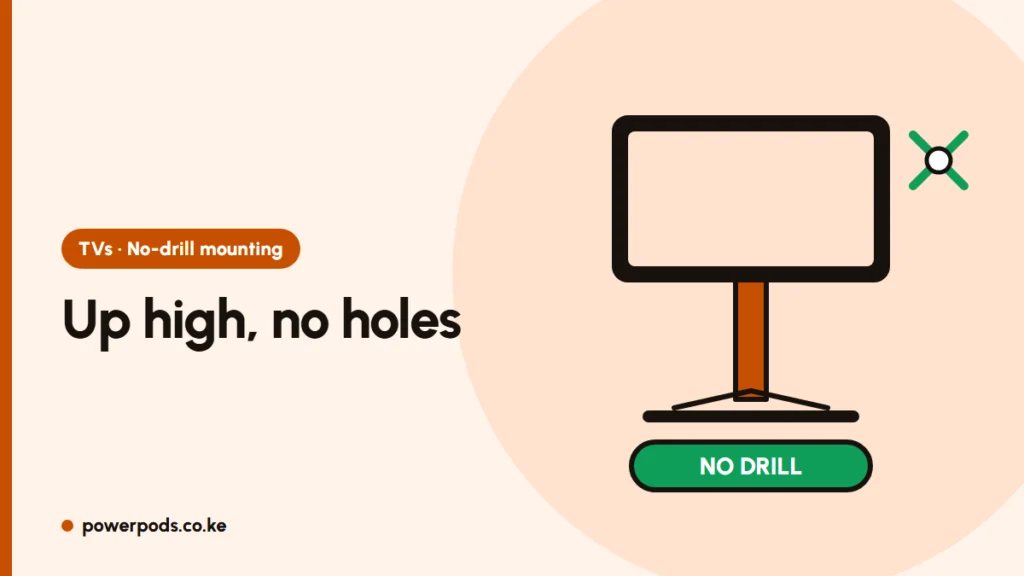
You can’t safely mount a TV without drilling onto the wall itself, but you can get the same wall-mounted look with a floor-standing TV stand that carries the weight on the floor instead of the wall. That is the safest no-drill option for most TVs over 32 inches, and the one renters use most.
Can you really mount without drilling?
A wall mount holds a TV with bolts into solid wall; nothing that sticks on does the same job. No-drill options work by moving the weight somewhere else: the floor, a table or a piece of furniture.
If you rent in Nairobi or Mombasa, check your tenancy agreement first. Many landlords deduct from the deposit for holes, but some allow a bracket if you ask, especially if you fill the holes when you leave. Ask by WhatsApp and keep the reply.
Floor-standing and easel TV stands
- Pole floor stand (mobile or fixed): a steel upright on a wide base, with a standard VESA plate that bolts to the back of the TV like a wall bracket. It gives wall-mount height, can stand right against the wall, and moves with you.
- Easel or tripod stand: a stylish three-leg frame. Best for lighter, smaller TVs.
- Tabletop swivel stand: replaces the TV’s own feet with a central pedestal so the screen can turn and sit higher on a unit.
Before you buy, check three numbers on the stand: maximum weight, screen size range and the VESA hole pattern (for example 400 x 400). Your TV’s weight and VESA size are in its manual or on the label at the back. Choose a stand rated comfortably above your TV’s weight. For fitting the TV’s own legs instead, see how to attach a TV to its stand, and for the right screen height, the TV mount height chart.
Minimal-hole options
If the landlord agrees to a few holes:
- A slim fixed bracket uses only a handful of screw holes, which a fundi can fill and paint when you move out.
- Ask about reusing existing holes from a previous tenant’s bracket, if they suit your TV’s size and the wall is solid.
- Anchor the stand, not the TV. On a stand or unit, one small screw for an anti-tip strap keeps the TV from being pulled over by children.
The full bracket method is in how to mount a TV on the wall.
What to avoid (adhesive strips)
Don’t hang a TV on adhesive pads, foam tape or picture-hanging strips. Most are rated for picture frames, not TVs, and products that claim to hold a TV depend on perfect surface preparation and curing time. Heat, humidity, dust and painted or plastered walls all weaken the bond, and a TV that falls can injure someone, not only break.
Never just lean a TV against the wall; it slides and tips. Tidy the cables either way: how to hide TV wires.
Quick answers
Not safely on the wall itself, but a floor-standing TV stand with a VESA plate gives the same raised look with no holes.
Generally no. Adhesive strips and pads can fail with heat, humidity or poor wall paint, and a falling TV is a real injury risk.
Use a pole floor stand that sits against the wall, or ask your landlord’s permission for a slim bracket and fill the holes when you leave.